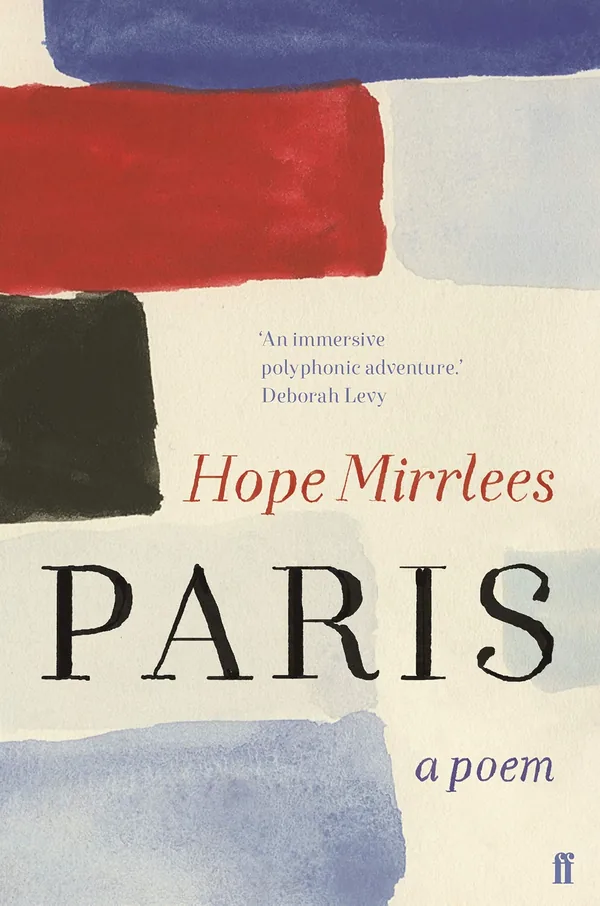
A 600-line masterpiece of early modernist poetry, written and published two years before T. S. Eliot’s The Waste Land, but, for various reasons, remained underestimated by critics and the public during Hope Mirrlees’s lifetime. An achievement and the clear peak in the poetic career of the 31-year-old authoress (who would later, in 1926, publish a cult fantasy novel, “Lud-in-the-Mist”), “Paris”, meanwhile, exerted an undeniable influence on Virginia Woolf’s novel “Mrs Dalloway”—and it was, in fact, Virginia and Leonard Woolf’s publishing house that brought out the first edition of the poem in 1919.
The poem takes the form of a single-day young lady’s stroll through post-war Paris, during which she describes the city through the visual clutter of signs, street names, memorial plaques, sounds, snatches of conversation, and stray thoughts that arise, as well as through the offbeat typography, including all-caps, indentations, and line breaks. It is both experimental and remarkably cohesive, immersing the reader in the very space it describes. Although much of the context—such as specific brands or references to past phenomena—may now require explanation to a contemporary reader, Mirrlees’s “Paris” brilliantly conjures the spirit of one of the world’s most brilliant cities, imbued with traces of very real life and grim historical events.
You can learn more about the poem’s history, view scans of its first edition, and read a digital version on a website dedicated to “Paris”.