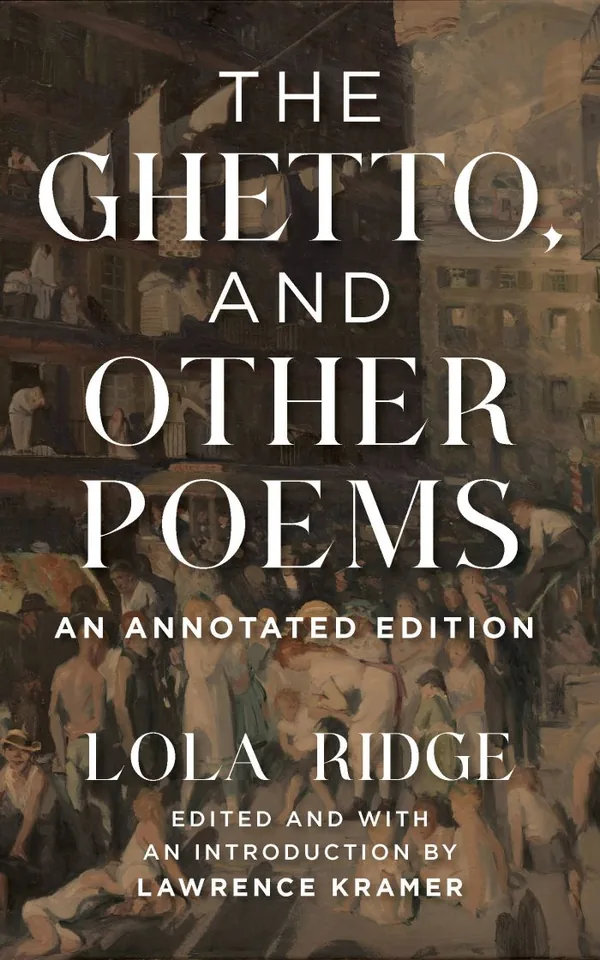
Lola Ridge’s debut poetry collection, published by B. W. Huebsch in 1918, centers on the poem “The Ghetto”—a modernist depiction of Jewish immigrants’ lives near Hester Street (Lower East Side, Manhattan).
In this title poem, Ridge interweaves observations of city life and the urban environment with perspectives on poverty, immigration, gender, labor, and social injustice, using free verse and rapidly shifting perspectives between present and past, youth and age, passion and pain. These formal experiments were closely intertwined with Ridge’s leftist and feminist convictions and provide grounds for considering her the first and most important proletarian poet of America.
“The Ghetto” occupies the opening and largest section of the collection, followed by poems including “Manhattan,” “Broadway,” “Bowery Afternoon,” “The Song of Iron,” “Frank Little at Calvary,” and “Brooklyn Bridge,” completing the picture of early 20th-century metropolitan life and the people—especially immigrants and workers—often pushed to its margins.
A key but long-neglected collection of early American modernist poetry, this new edition is brilliantly annotated by Fordham University professor, musicologist, and composer Lawrence Kramer, who provides thorough historical context and highlights that Ridge should be regarded as a leading poet of her era.